
How to play AFL: a beginner’s guide
Learn the first skills, try three non-contact drills and arrive at your first training session knowing what to expect.
Australian rules football / practical introduction / reviewed 4 November 2026
The quick answer
Start by learning to control the ball, handball to a nearby partner, kick a short drop punt and catch an easy return. You can practise these skills without playing a full match. Add movement gradually; distance and speed can come later.
In a match, teams move an oval ball towards goal by kicking, handballing and running. Men’s AFL has 18 players per team on the field. A legal goal scores six points; a behind scores one. Community, junior and modified formats can use different arrangements. 2026 laws.
This guide is for a newcomer’s first steps. The practice activities below are original SportsPedia suggestions for an open, clear area, with no tackling, jumping contests or opposition pressure. Children should practise with an adult supervising. Use your organiser’s instructions for the actual session.
Choose the right starting point: if you want to understand a match, follow the rules guide. If you want to try the skills yourself, start with the three explanations below. AFL PLAY’s beginner videos show the skills in motion.
1. Kicking: start with a short drop punt
A drop punt is a useful first kick to learn. Think about sending the ball to a partner who can receive it comfortably, rather than kicking as far as possible.
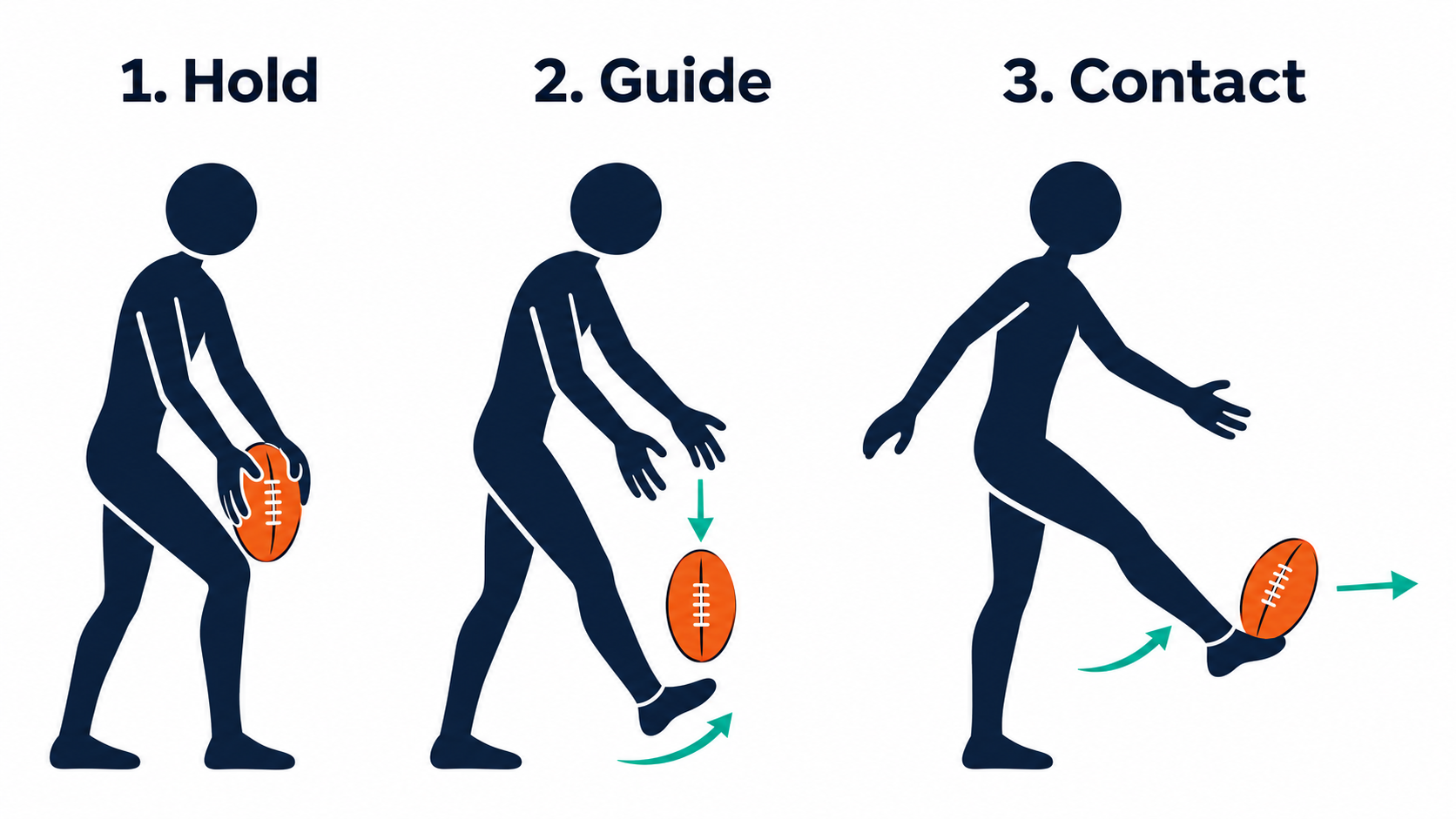
- Set up towards the target. Hold the ball over the thigh of your kicking leg, with fingers along its sides.
- Guide the ball down. Use the hand on your kicking side to control its release towards the boot. Watch the ball through contact.
- Meet the lower point and follow through. The lower part of the laces contacts the ball’s lower point; continue the leg towards the target. The aim is controlled, end-over-end flight.
Technique reference: Australian Football International’s kicking guide. A coach can help adjust your ball drop and foot contact. For your first attempts, use gentle kicks over a manageable distance.
2. Handballing: support, then strike
A handball is a strike with a fist while the other hand supports the ball. It is different from throwing the ball to your teammate.
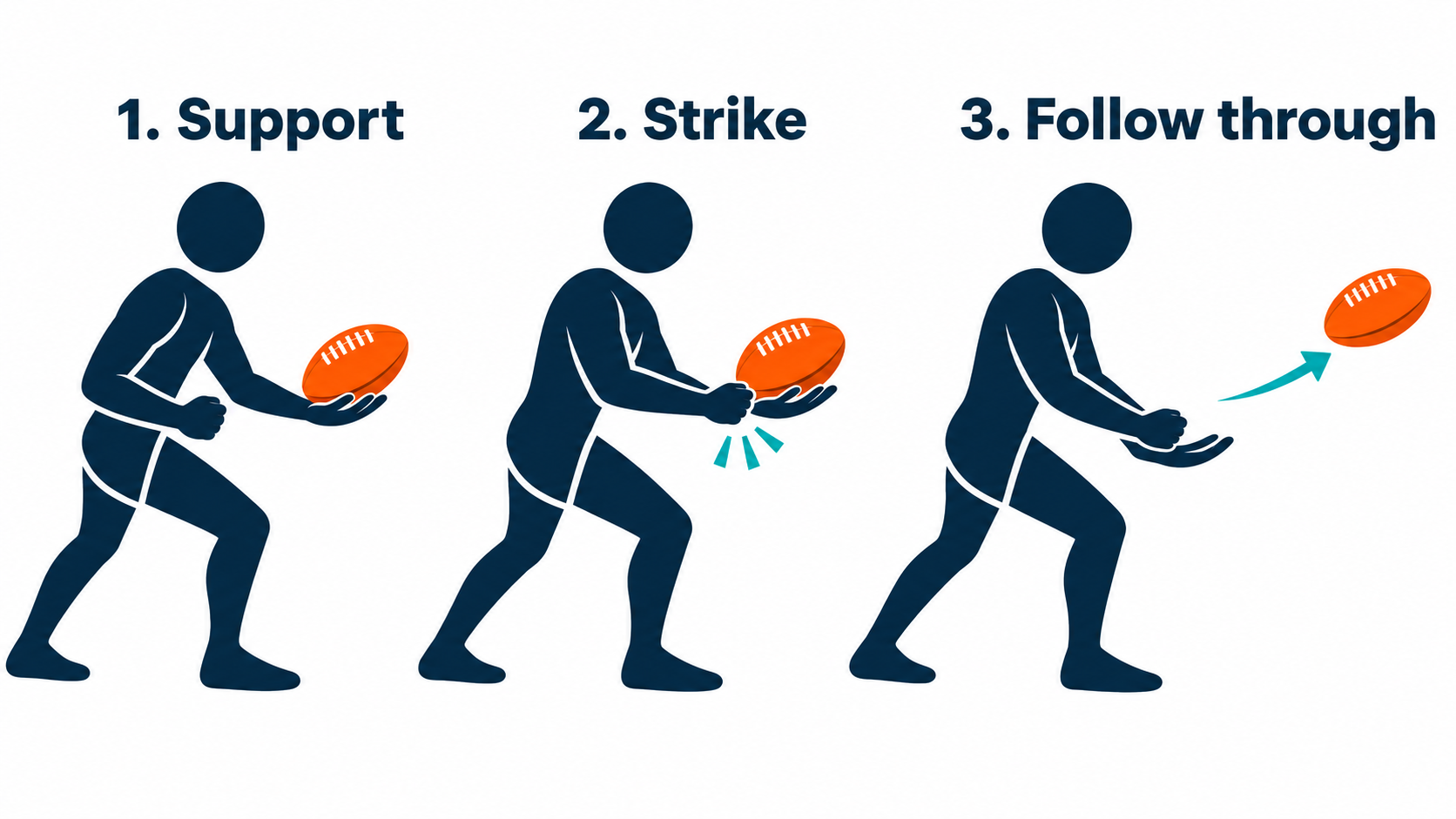
- Make a platform. Hold the ball steadily in one hand and look at it.
- Form the striking fist. Keep the thumb outside the fingers. A slightly side-on stance gives the arm room to move.
- Strike towards the receiver. Punch the back of the ball with the other fist, rather than tossing it up first. Begin with short, controlled passes.
Technique reference: Australian Football International’s handballing guide. Ask your partner whether the pass arrives where they can catch it; that feedback is more useful than simply adding power.
3. Marking: learn an easy chest catch
Begin with a gentle, uncontested feed. Your first aim is to watch the ball into your hands and secure it, rather than jump for a spectacular catch.
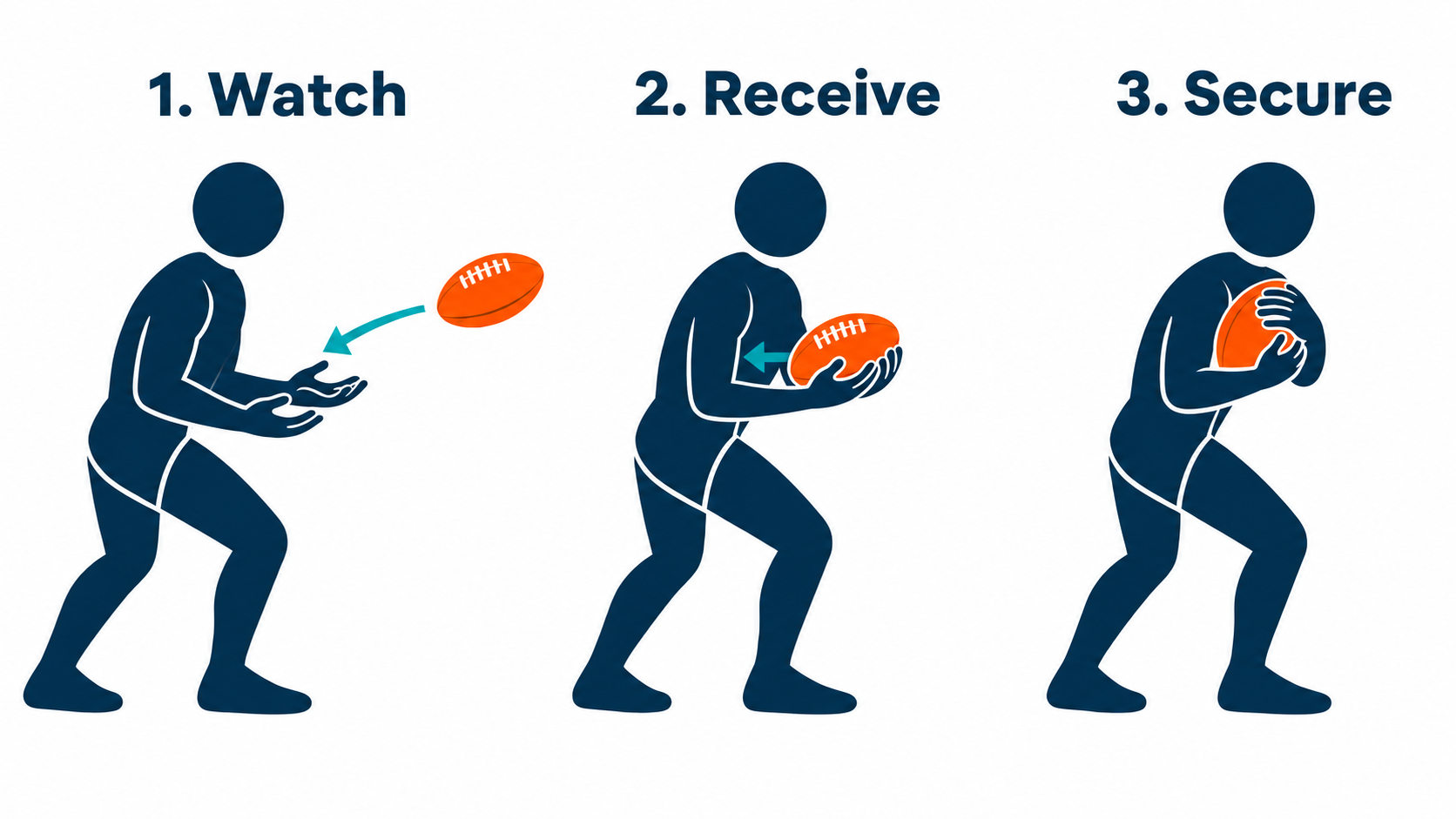
- Watch the ball throughout its flight. Move into line early so your body is behind its path.
- Prepare your hands and arms. For a chest catch, present your hands in front, palms up, with elbows close to your sides.
- Guide it in and secure it. Receive the ball on your hands and forearms and bring it into the chest.
Technique reference: Australian Football International’s marking guide. Practise with an easy feed before adding movement.
A practice catch is not automatically a match mark. Under the laws, a qualifying kick must travel at least 15m and remain untouched by another player or the ground before the catch. The umpire judges the mark. Short kicks and gentle throws used to practise catching do not create that match entitlement. Marks and what happens next.
Three simple non-contact practice drills
These are SportsPedia practice ideas, not an official AFL training prescription. Use a ball size you can handle, leave clear space around each pair and agree when to send the next ball. Stop and reset if another person enters the practice lane.
DRILL 01 / TWO PEOPLE
Short-pass exchange
Set up: face a partner a few comfortable steps apart. One ball is enough.
- Stand still and send an easy handball to your partner.
- The receiver secures it, resets their feet and handballs back.
- Try a short set of controlled exchanges. Swap striking hands if you can keep the action comfortable.
Make it easier: shorten the gap. Progress it: after each catch, take one sideways step, stop and pass again. Keep the target predictable.
DRILL 02 / TWO PEOPLE
Kick, collect and reset
Set up: choose a clear lane and a distance at which both players can kick gently.
- Player A sends a short drop punt towards Player B.
- Player B receives it or lets it land and collects it. A clean catch is a bonus, not a requirement.
- Both players reset before the return kick. Work on a repeatable ball drop rather than distance.
Make it easier: shorten the kick or pause for a coach’s demonstration. Progress it: aim for a small receiving area marked with two cones, while keeping the receiver clear of the kicker.
DRILL 03 / TWO PEOPLE
Move, face and receive
Set up: put two cones a few steps apart. One player is the feeder; the other walks between the cones.
- The receiver walks to a cone, turns and faces the feeder.
- The feeder waits until the receiver is ready, then provides a gentle chest-height feed.
- The receiver catches, returns the ball and walks to the other cone. Swap roles.
Make it easier: stay at one cone. Progress it: use a controlled handball as the feed. There is no defender and no race to the ball.
For an official activity with movement and handballing, see AFL PLAY’s Handball Hotshots sheet. Its group setup and supervision instructions belong to that activity; the three drills above are our own introductory options.
An optional short practice session
| Approximate time | Activity |
|---|---|
| 3 minutes | Check the space, move gently and get used to holding and collecting the ball. |
| 5 minutes | Short-pass handball exchanges. |
| 5 minutes | Gentle drop punts, with time to collect and reset. |
| 5 minutes | Easy chest catches, then move-and-receive practice. |
| 2 minutes | Discuss one thing that felt easier and one question for a coach. |
Common beginner mistakes and useful resets
Trying to kick further before you can guide the ball
Return to a short kick. Check the ball’s position and release before increasing distance. One useful question is: “Did the ball go where I aimed, at a pace my partner could receive?”
Tossing the ball before handballing
Keep the ball supported until the fist strikes it. Practise the action slowly with a coach or partner watching.
Looking away just before the catch
Go back to an easy, uncontested feed and follow the ball into your hands. Add movement after you can track the simple feed.
Practising every skill at match speed
Separate the task: first receive, then settle, then pass. You can connect the actions later. Speed should not make your partner guess whether you are ready.
Assuming every competition uses AFL men’s rules
Ask which format you are joining. Player numbers, contact, ground size and match arrangements can differ. Learn the organiser’s version before applying something you saw on television.
Your first training session: a checklist
- Before you go: confirm the location, start time, age group and whether the session welcomes beginners. Tell the organiser you are new.
- Ask what is supplied: ball size, footwear, uniform and any required protective equipment. Our equipment guide explains those questions.
- Bring the basics: water, suitable clothing and what the organiser asks you to bring.
- At the start: identify the coach, explain your experience and ask which group to join. Check what happens if you need a break.
- During practice: ask for a demonstration, agree when to pass and reset after a loose ball.
- Before leaving: ask when the next beginner session is and choose one skill to practise in between.
Contact and contested skills should be introduced by a qualified coach in the appropriate program. The drills on this page deliberately leave out tackling, bumps and contested jumping.
Explore AFL PLAY’s learning resources and participation options, or speak with a local club about an appropriate introduction.
Connect the skills to a match
After disposing of the ball, look for a useful place to move rather than following it into every contest. Watch how a teammate can provide a short option while another moves further ahead. The positions guide explains how forwards, midfielders, rucks and defenders connect.
In the 2026 AFL competition, centre throw-ups start quarters and restart play after goals. A ball carrier must bounce or touch the ball on the ground at least once every 15m. Boundary decisions depend on how and where the ball goes out. 2026 laws; AFL boundary examples.
Keep the detailed references nearby: scoring, holding the ball and the labelled ground. You do not need to memorise every rule before asking to join a beginner session.
Sources and review
- Skill teaching cues: Australian Football International’s kicking, handballing and marking resources.
- Demonstrations: AFL PLAY Learn to Play and the Coach Skills Series.
- Additional official activity: Auskick Handball Hotshots.
- Match-rule reference: Laws of Australian Football 2026, including Laws 13, 15, 16 and 18.
Reviewed . Illustrations, three practice drills and the example session are original SportsPedia teaching aids. They simplify the skills and do not reproduce an official AFL training program. Competition regulations and a coach’s instructions govern organised sessions.
Keep exploring AFL
AFL hub · Positions · Rules · Equipment · Club directory