
AFL field size and markings explained
Read the oval: its dimensions, centre markings, scoring ends and the lines that help you follow a match.
How big is an AFL field?
The 2026 laws diagram gives a playing-area range of 135–185 metres long and 110–155 metres wide. Grounds can differ; there is no single measurement that describes every oval. The controlling body can approve smaller surfaces in the circumstances set out in Law 3.7.
Measure the playing surface, rather than the entire stadium or the space behind the fence. For a particular venue, check that ground’s current specifications.
An original guide to the oval
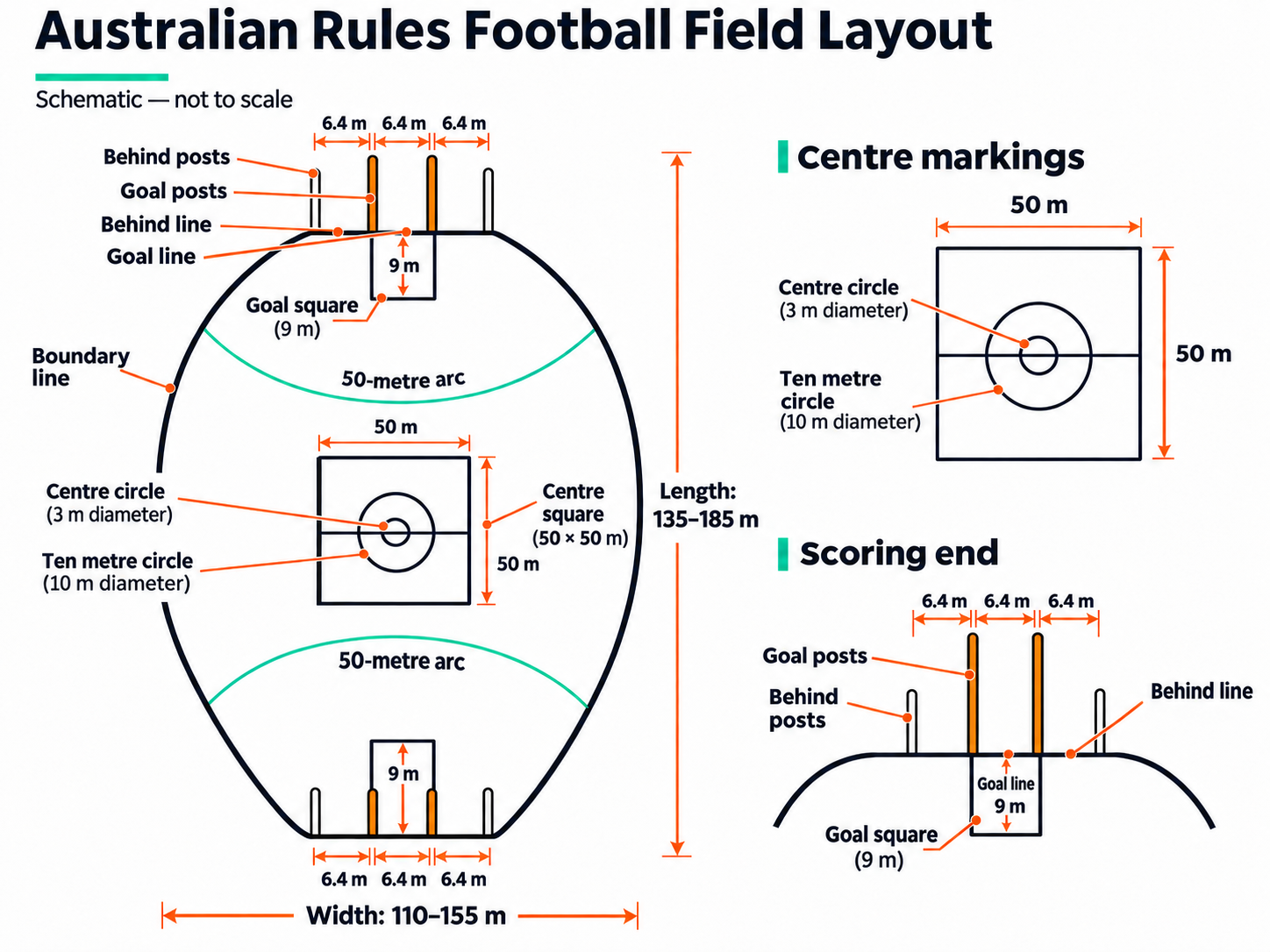
Field markings: a quick reference
| Feature | What it shows |
|---|---|
| 50-metre arcs | Curves 50m from each goal line. They are useful distance references. |
| Centre square | 50m × 50m, around the centre restart area. |
| Centre circles | Diameters of 3m and 10m, in the middle of the square. A dividing line runs parallel to the goal lines. |
| Goal squares | Extend 9m into the field; the front is the kick-off line. |
| Four posts | Two central goal posts, with a behind post outside each. Adjacent posts are 6.4m apart. |
| Boundary | The oval’s outside limit. How the ball crosses it affects the restart. |
Use the markings to follow the play
Start in the middle
In the 2026 AFL competition, the centre restart is a throw-up. Older match footage may show centre bounces. Watch the rucks contest the ball, then follow where the midfielders move to receive it. The centre square and circles are nested markings, rather than separate zones on opposite sides of the oval. AFL’s 2026 restart changes.
Look at the next kick
Imagine a player taking a mark just outside the 50m arc. The arc gives a distance cue, but the player might shoot, pass sideways or kick to a teammate closer to goal. It is a field marking, rather than an instruction to take a shot.
Check the boundary decision
A ball leaving the playing area can produce a throw-in or a free kick. In men’s AFL, the 2026 last-disposal rule applies between the arcs. Read our worked boundary examples alongside this diagram.
Watching positions? Use the positions oval for forwards, midfielders, rucks and defenders. This drawing explains the ground’s markings; players’ roles and movement belong on their own diagram.
Sources and review
- Laws of Australian Football 2026: Laws 3.3–3.7, diagram 1 and Law 13.
- AFL’s explanation of the 2026 changes: centre throw-ups and last disposal.
Reviewed . General ground reference with AFL competition examples; junior, community and other formats may use modified arrangements.
Keep exploring
Positions and player movement · Practical rules explained · Read the scoreboard · Back to the AFL hub